Earlier this year, we mentioned that we're bringing computer use capabilities to developers via the Gemini API. Today, we are releasing the Gemini 2.5 Computer Use model, our new specialized model built on Gemini 2.5 Pro’s visual understanding and reasoning capabilities that powers agents capable of interacting with user interfaces (UIs). It outperforms leading alternatives…

Micromobility solutions—such as delivery robots, mobility scooters, and electric wheelchairs—are rapidly transforming short-distance urban travel. Despite their growing popularity as flexible, eco-friendly transport alternatives, most micromobility devices still rely heavily on human control. This dependence limits operational efficiency and raises safety concerns, especially in complex, crowded city environments filled with dynamic obstacles like pedestrians and…
Image by Author
# Introduction
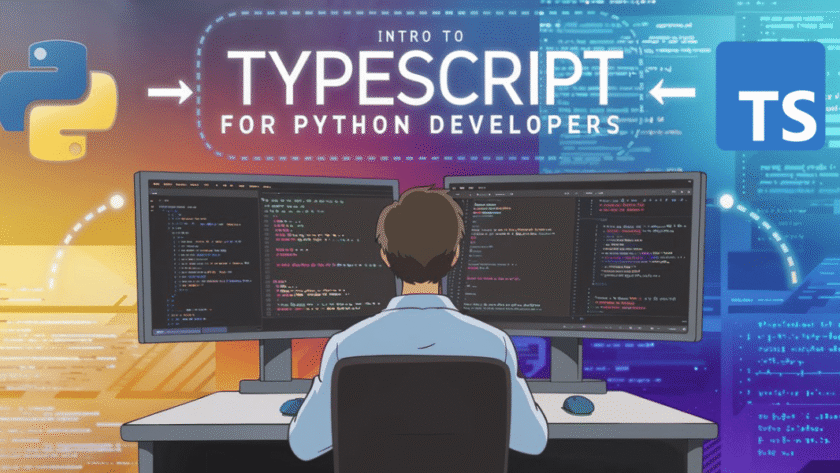
You've been coding in Python for a while, absolutely love it, and can probably write decorators in your sleep. But there's this nagging voice in your head saying you should learn TypeScript. Maybe it's for that full-stack role, or perhaps you're tired of explaining why Python is "totally…
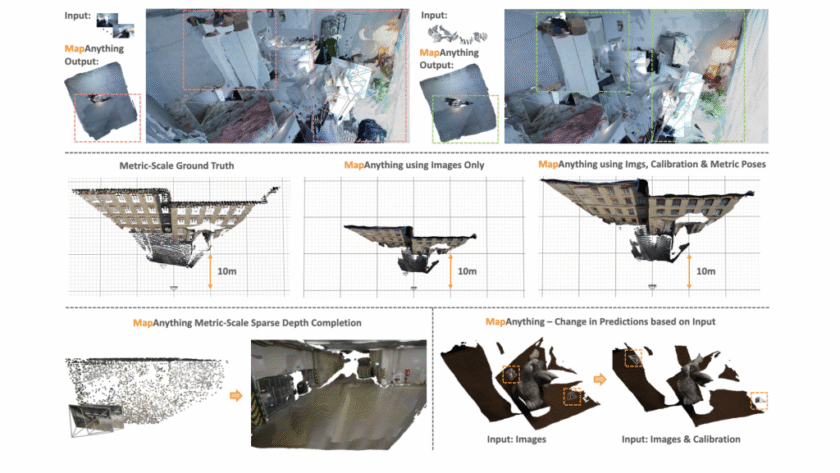
A team of researchers from Meta Reality Labs and Carnegie Mellon University has introduced MapAnything, an end-to-end transformer architecture that directly regresses factored metric 3D scene geometry from images and optional sensor inputs. Released under Apache 2.0 with full training and benchmarking code, MapAnything advances beyond specialist pipelines by supporting over 12 distinct 3D vision…
Responsibility & Safety
Published
6 October 2025
…
Estimated reading time: 5 minutes
Introduction
Embodied AI agents are increasingly being called upon to interpret complex, multimodal instructions and act robustly in dynamic environments. ThinkAct, presented by researchers from Nvidia and National Taiwan University, offers a breakthrough for vision-language-action (VLA) reasoning, introducing reinforced visual latent planning to bridge high-level multimodal reasoning…
Image by Editor
# Introduction
One of the most difficult pieces of machine learning is not creating the model itself, but evaluating its performance.
A model might look excellent on a single train/test split, but fall apart when used in practice. The reason is that a single split tests the model only…
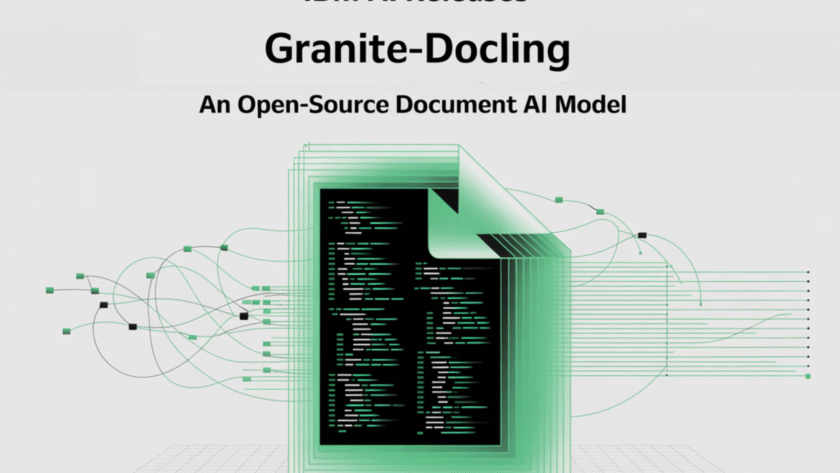
IBM has released Granite-Docling-258M, an open-source (Apache-2.0) vision-language model designed specifically for end-to-end document conversion. The model targets layout-faithful extraction—tables, code, equations, lists, captions, and reading order—emitting a structured, machine-readable representation rather than lossy Markdown. It is available on Hugging Face with a live demo and MLX build for Apple Silicon.
What’s new compared to…
We’re expanding our risk domains and refining our risk assessment process. AI breakthroughs are transforming our everyday lives, from advancing mathematics, biology and astronomy to realizing the potential of personalized education. As we build increasingly powerful AI models, we’re committed to responsibly developing our technologies and taking an evidence-based approach to staying ahead of emerging…
Can a single AI stack plan like a researcher, reason over scenes, and transfer motions across different robots—without retraining from scratch? Google DeepMind’s Gemini Robotics 1.5 says yes, by splitting embodied intelligence into two models: Gemini Robotics-ER 1.5 for high-level embodied reasoning (spatial understanding, planning, progress/success estimation, tool-use) and Gemini Robotics 1.5 for low-level visuomotor…