Skip to content Skip to sidebar Skip to footer

Robotics

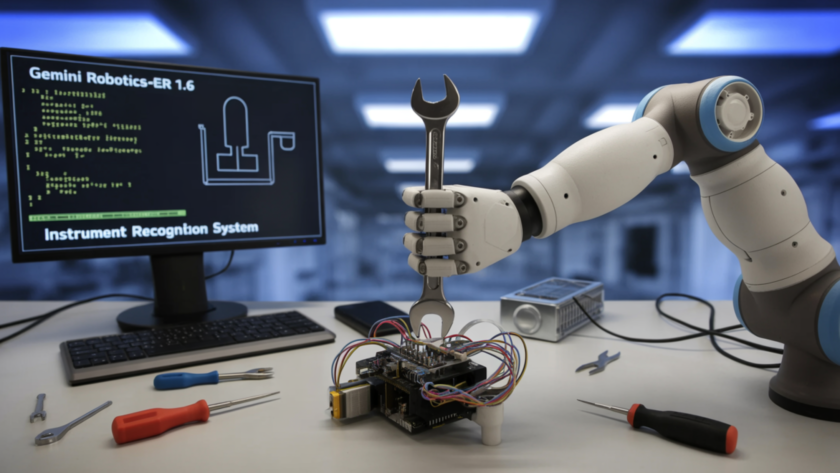
Google DeepMind Releases Gemini Robotics-ER 1.6: Bringing Enhanced Embodied Reasoning and Instrument Reading to Physical AI

Google DeepMind research team introduced Gemini Robotics-ER 1.6, a significant upgrade to its embodied reasoning model designed to serve as the ‘cognitive brain’ of robots operating in real-world environments. The model specializes in reasoning capabilities critical for robotics, including visual and spatial understanding, task planning, and success detection — acting as the high-level reasoning model…

Read More

How to Build Advanced Cybersecurity AI Agents with CAI Using Tools, Guardrails, Handoffs, and Multi-Agent Workflows

In this tutorial, we build and explore the CAI Cybersecurity AI Framework step by step in Colab using an OpenAI-compatible model. We begin by setting up the environment, securely loading the API key, and creating a base agent. We gradually move into more advanced capabilities such as custom function tools, multi-agent handoffs, agent orchestration, input…

Read More

Physical Intelligence Team Unveils MEM for Robots: A Multi-Scale Memory System Giving Gemma 3-4B VLAs 15-Minute Context for Complex Tasks

Current end-to-end robotic policies, specifically Vision-Language-Action (VLA) models, typically operate on a single observation or a very short history. This ‘lack of memory’ makes long-horizon tasks, such as cleaning a kitchen or following a complex recipe, computationally intractable or prone to failure. To address this, researchers from Physical Intelligence, Stanford, UC Berkeley, and MIT have…

Read More

NVIDIA Releases DreamDojo: An Open-Source Robot World Model Trained on 44,711 Hours of Real-World Human Video Data

Building simulators for robots has been a long term challenge. Traditional engines require manual coding of physics and perfect 3D models. NVIDIA is changing this with DreamDojo, a fully open-source, generalizable robot world model. Instead of using a physics engine, DreamDojo ‘dreams’ the results of robot actions directly in pixels. https://arxiv.org/pdf/2602.06949 Scaling Robotics with 44k+…

Read More

Ant Group Releases LingBot-VLA, A Vision Language Action Foundation Model For Real World Robot Manipulation

How do you build a single vision language action model that can control many different dual arm robots in the real world? LingBot-VLA is Ant Group Robbyant’s new Vision Language Action foundation model that targets practical robot manipulation in the real world. It is trained on about 20,000 hours of teleoperated bimanual data collected from 9…

Read More

Google DeepMind Introduces SIMA 2, A Gemini Powered Generalist Agent For Complex 3D Virtual Worlds

Google DeepMind has released SIMA 2 to test how far generalist embodied agents can go inside complex 3D game worlds. SIMA’s (Scalable Instructable Multiworld Agent) new version upgrades the original instruction follower into a Gemini driven system that reasons about goals, explains its plans, and improves from self play in many different environments. From…

Read More

Generalist AI Introduces GEN-θ: A New Class of Embodied Foundation Models Built for Multimodal Training Directly on High-Fidelity Raw Physical Interaction

How do you build a single model that can learn physical skills from chaotic real world robot data without relying on simulation? Generalist AI has unveiled GEN-θ, a family of embodied foundation models trained directly on high fidelity raw physical interaction data instead of internet video or simulation. The system is built to establish scaling…

Read More

URBAN-SIM: Advancing Autonomous Micromobility with Scalable Urban Simulation

Micromobility solutions—such as delivery robots, mobility scooters, and electric wheelchairs—are rapidly transforming short-distance urban travel. Despite their growing popularity as flexible, eco-friendly transport alternatives, most micromobility devices still rely heavily on human control. This dependence limits operational efficiency and raises safety concerns, especially in complex, crowded city environments filled with dynamic obstacles like pedestrians and…

Read More

NVIDIA AI Presents ThinkAct: Vision-Language-Action Reasoning via Reinforced Visual Latent Planning

Estimated reading time: 5 minutes Introduction Embodied AI agents are increasingly being called upon to interpret complex, multimodal instructions and act robustly in dynamic environments. ThinkAct, presented by researchers from Nvidia and National Taiwan University, offers a breakthrough for vision-language-action (VLA) reasoning, introducing reinforced visual latent planning to bridge high-level multimodal reasoning…

Read More